Become a Sustainability Trivia Champion
Spring 2026: Celebrating a Decade of Impact

The contest below is from a promotion in spring 2026, and the contest is complete. However, the content below is still valuable to learn about some of Notre Dame's sustainability work.
In 2015, the late Pope Francis released Laudato Si’, the 2015 papal encyclical on ecology and human responsibility that calls all people to care for our common home. This document served as the inspiration and launching point for the University’s Comprehensive Sustainability Strategy, which was published in 2016.
Ten years later, this strategy has helped Notre Dame exemplify Pope Francis’ vision through on-campus projects and practices that model support for the three pillars of sustainability: environmental, social, and economic well-being.
Throughout this semester, via this FAQ and other engagement opportunities with ND Sustainability, we plan to highlight a variety of key achievements from the last decade. Let’s get started!
How to play ND Sustainability Trivia:
-
Read each week’s sustainability FAQ.
-
Answer the trivia question by completing the Google Form. Hint: the answer will be hidden in the FAQ.
- For each week you submit the correct answers, your name will be added to a raffle drawn at the end of the series (end of the spring 2026 semester). The more questions you get right over the course of the series, the better your odds are of your name being selected. You can also earn additional entries by re-posting one or more @sustainablend Instagram posts related to this series. Just be sure to DM us, tag us, or otherwise let us know you shared so we can count your entry. The winner of the raffle gets a secret prize!
Ready to become a Sustainability Trivia Champion? Start playing today!
Prize Updates
Thank you to everyone who participated in the spring semester FAQ series. We hope you learned more about sustainability efforts on campus! Congratulations to our winners, student sustainability commissioner, Delaney Laffler (right), and staff member in the College of Engineering Dean's Office, Megan Snyder (left).

Week 10: What is the Notre Dame Sustainability Team Excited About?
As we close out the spring semester, we are pleased to pause and recognize the hard work of those who have been working hard to make our campus more sustainable, including a variety of achievements already highlighted this semester. The journey is ongoing, though. For inspiration, here are a few items the Notre Dame Sustainability Team is excited about as the summer season begins.
-
Futhering Our Decarbonization Work: Over the last 10 years, despite the campus' physical footprint growing by 22 percent, the University has decreased its annual carbon emissions by 25 percent! This has been achieved through the consistent dedication of team members in Facilities Design & Operations, who have been at the helm of powering Notre Dame while continuing to upgrade and develop our campus. The University is excited to continue this work and plans to reach carbon neutrality by 2050. As of writing, we are about halfway to this goal—our campus has seen a 48 percent reduction in carbon emissions since 2005! Current and upcoming projects include the expansion of geothermal across campus, such as the Southeast Geothermal Plant coming online later this year. Just north of the Joyce Center, this plant joined a network of about 2,400 geothermal wells and is part of a larger goal to create a centralized geothermal system to serve the campus. Campus engineers and technicians are also slated to integrate geothermal heating and cooling systems in older campus buildings.
-
Building & Construction: Since 2008, Notre Dame has been constructing and retrofitting campus buildings to meet the Leadership in Energy and Environmental Design (LEED) certification, a globally recognized standard for sustainable architecture awarded by the U.S. Green Building Council. As of April 22, we are pleased to share that McCourtney II has been officially certified as a Platinum LEED building! This is Notre Dame’s first Platinum rating—the highest possible achievement—in its LEED portfolio. Alongside new construction, the University continues to invest in retro-commissioning, energy-efficient lighting, green roofs (Week 8), and smart building systems to support sustainability-minded operations.
-
Food Rescue and Reuse: Notre Dame will continue donating food from its dining halls and expanding food rescue efforts within the diverse event spaces across campus. We are also looking to identify whether there are additional locations on campus that can benefit from Leanpath and complement the Grind2Energy program, which already processes waste into nutrient-rich slurry for renewable energy and fertilizers. Need a refresher on food rescue and reuse? See Weeks 5-7!
-
Climate Action Planning: Notre Dame Sustainability will continue to work with campus operational partners to advance climate action planning work in food and dining, and has recently begun exploring next steps for reducing landfill waste.
-
Notre Dame’s Ongoing Sustainability Influence Continuing Outside Campus Boundaries: We’re excited about the growing work of the Just Transformations to Sustainability Initiative, especially the news of the Global Alliance for Laudato si’. Additionally, we are enthusiastic about the Pastoral Letter from the Catholic Bishops of Indiana: Integral Ecology, A Sacramental Vision, which was developed in collaboration with Fr. Terrence Ehrman, C.S.C. Finally, we’re excited about our students and the way that we see them get involved on campus, embracing Creation as a gift from God, while also knowing that they will take this mindset with them as they graduate and lead within our global community.
Ready to test your knowledge? Take the quiz for Week 10 here.
Week 9: What Did Notre Dame Accomplish in the 2025-2026 Academic Year?
Thanks to the University’s careful Climate Action Planning and to the collective effort of Notre Dame students, faculty, and staff, our campus has achieved substantial milestones in our sustainability journey over the past year! These have included:
- The West Campus Solar Project: The West Campus Solar Array near Dorr Road was completed and is now fully operational. The 46,000-square-foot solar array provides approximately 1% of campus electricity and avoids approximately 600-700 metric tons of metric tons annually, equivalent to removing nearly 130-150 cars from the road! This project is part of the University’s broader effort to diversify its energy supply.
- Green Roof Expansion: Notre Dame’s green roof network continued to expand, with new installations on Rockne Memorial and South Dining Hall, bringing the campus total to 212,000 square feet—or over 4 acres—of green roofs! Need a refresher on green roofs? See Week 8.
- Food Rescue and Reuse: Food from campus dining halls, the Center for Culinary Excellence, and athletic events was donated through Cultivate Food Rescue, providing 39,860 meals for the South Bend-Elkhart region in Fall 2025 alone! Food that could not be consumed was converted into energy, fertilizer, and bedding at a local dairy farm through our Grind2Energy system. Need a refresher on Cultivate and Grind2Energy? See Week 6.
- Recycling Improvements: Thanks to coordinated efforts among students, Stadium Operations, Building Services, and Sustainability staff, recycling performance improved significantly across campus. In Fall 2025, everyday recycling collection increased by 62%, and football gameday recycling improved by 80% relative to Fall 2024.
Ready to test your knowledge? Take the quiz for Week 9 here.
Eager to learn more? Find more information about our 2025 progress here.
Week 8: What is a Green Roof? How Many Green Roofs has Notre Dame Installed?
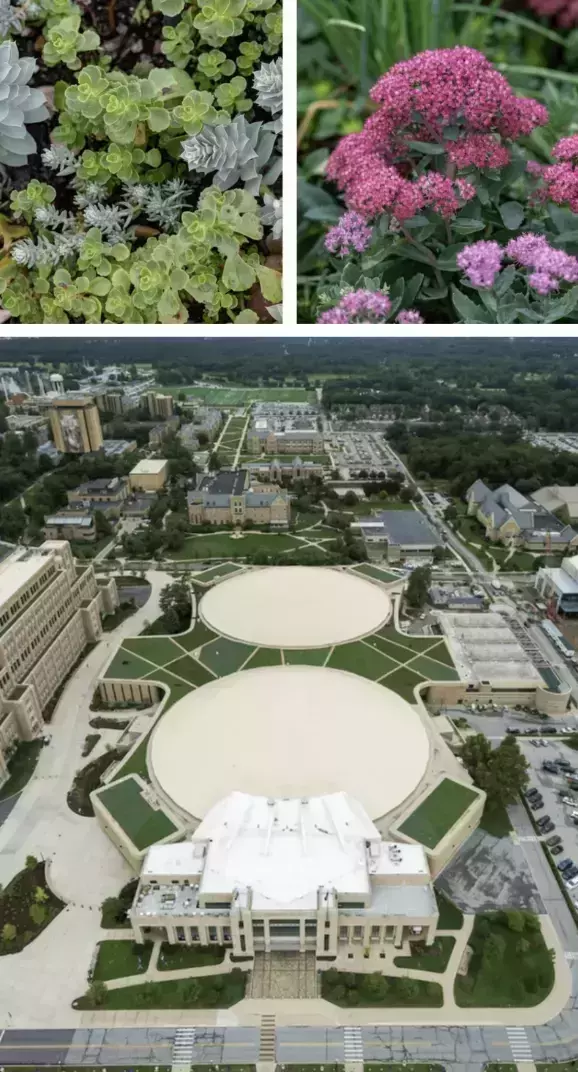
A green roof, or living roof, is a rooftop covered with vegetation planted over a waterproof membrane. Green roofs provide several immediate and long-term benefits, including:
-
Insulating buildings to keep interiors cooler in the summer and warmer in the winter.
-
Shielding roof membranes from UV radiation and extending their lifespan beyond that of a traditional roof.
-
Capturing and conserving rainwater, reducing stormwater runoff.
-
Supporting biodiversity by providing food sources for beneficial pollinators, like birds and bees.
-
Reducing the heat island effect and lowering ambient temperatures.
What green roofs exist at Notre Dame?
In 2009, Notre Dame installed its first green roof atop the Morris Inn. Since then, installations have expanded significantly. As of writing, the University has ten green roofs totaling about 212,000 square feet, including the 68,900-square-foot roof atop the Joyce Center, the largest in Indiana. That’s over 4 acres of green roof!
For the most up-to-date list of green roofs and other sustainability initiatives, check out our Sustainability Map.
What do Notre Dame’s green roofs look like?
Notre Dame’s green roofs feature plant layouts designed for aesthetics and sustainability. They typically include a variety of plant species—primarily sedum, a drought-tolerant, shallow-rooted succulent—arranged in interlocking trays with a few inches of soil to create a lush, patterned surface.
Ready to test your knowledge? Take the quiz for Week 8 here.
Eager to learn more? Discover how green roofs and other building and construction efforts at Notre Dame help to care for our common home.
Week 7: What is Grind2Energy? How Has It Advanced Notre Dame’s Food Reuse Efforts?

In Notre Dame’s 2016 Sustainability Strategy, mitigating food waste was identified as a key focus area. After extensive evaluation of food waste diversion options in the region, Notre Dame began using Grind2Energy in 2019 to manage food scraps that cannot be donated.
How does the Grind2Energy system work?
Food scraps and post-consumer leftovers from the Dining Halls and Center for Culinary Excellence that are not suitable for donation are placed into the Grind2Energy system, where they are ground and mixed into a liquid slurry. The slurry is then transported off campus to a local farm. At the farm, Homestead Dairy, an anaerobic digester breaks down the slurry and converts it into biogas, which is used to create power. Other by-products include fertilizer and bedding for cows. Check out this video to learn more! In the fall semester alone, these systems diverted food scraps from the landfill that avoided emissions equal to the carbon emissions sequestered by 91 acres of forest in a year.
During Earth Month 2025, students, faculty, and staff had the opportunity to visit Homestead Dairy and got to meet the cows who reaped the benefits!
Ready to test your knowledge? Take the quiz for Week 7 here.
Week 6: How Has Notre Dame Expanded Its Food Rescue Efforts With Cultivate?

Over the past decade, Notre Dame has strengthened its approach to reducing food waste by building long-term community partnerships. Since 2016, the University has partnered with Cultivate Food Rescue, a South Bend–based nonprofit committed to reducing food waste and fighting hunger in the South Bend-Elkhart region. Through this partnership, surplus food from campus is recovered and repurposed into nutritious meals, helping feed those in need while also minimizing waste in alignment with the EPA Wasted Food Scale.
One of Cultivate’s signature initiatives is the Weekend Backpack Program, which provides meals to K-12 students facing food insecurity.
Here’s how the program works:
-
Notre Dame’s dining halls, the Center for Culinary Excellence, and athletic events follow strict food safety protocols and ensure donated food remains at safe temperatures until it is handed off to Cultivate.
-
Cultivate collects the unused, high-quality food.
-
The rescued food is portioned into balanced, ready-to-eat meals at Cultivate’s facilities.
-
Meals are distributed to people in our community.
How has Notre Dame contributed to this program?
Since 2017, Notre Dame has donated 226.65 tons of food to Cultivate, equating to over 453,000 meals! Each week, Cultivate visits the campus to rescue food for our hungry neighbors.
Ready to test your knowledge? Take the quiz for Week 6 here.
Learn how you can support Cultivate’s mission by volunteering to pack meals.
Week 5: What is the EPA Wasted Food Scale? How Has Notre Dame Been Using It?
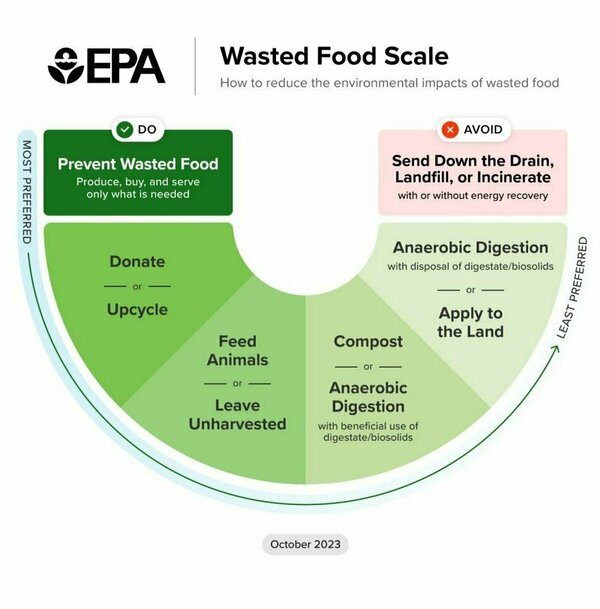
The EPA Wasted Food Scale is a tool developed by the U.S. Environmental Protection Agency that ranks different ways of handling food that goes unused, from most beneficial to least. At the top of the scale are strategies like preventing food waste, donating food, and upcycling, which help keep food in use. At the bottom are less desirable options like dumping food in landfills, incineration, or sending it down the drain.
How Has Notre Dame Been Using the EPA Wasted Food Scale Since 2016?
The University prioritizes its food waste strategy in accordance with the waste food scale. Below are Notre Dame’s primary strategies.
-
Prevent wasted food: In 2015, Notre Dame adopted Leanpath, a food waste prevention tool that helps track and analyze discarded food in campus dining halls. By measuring what is wasted and why, Leanpath helps Notre Dame Dining make informed adjustments to purchasing, preparation, and menu planning.
-
Donate or upcycle: Notre Dame partners with Cultivate Food Rescue, a local nonprofit that rescues surplus food from campus dining halls to create nutritious meals for food-insecure individuals in the Michiana community. Stay tuned for more information about this partnership next week!
-
Feed animals: Vegetable trimmings that are not safe for human consumption but are suitable for animal feed are donated to a local cattle farmer.
-
Anaerobic digestion: Food waste that cannot be donated is processed through the Grind2Energy system, which converts food scraps into a liquid slurry. This slurry is then transported to a local farm, where anaerobic digesters turn it into renewable energy, fertilizer, and animal bedding. Stay tuned to learn more about Grind2Energy in an upcoming FAQ!
Ready to test your knowledge? Take the quiz for Week 5 here.
Eager to learn more? Visit our Food page.
Week 4: What is LEED? How Many Buildings Have Been LEED-Certified Since 2016?
LEED, which stands for Leadership in Energy and Environmental Design, is an internationally recognized green building certification program developed by the U.S. Green Building Council. Buildings can earn different levels of certification (Certified, Silver, Gold, or Platinum) depending on how many sustainability-focused credits they achieve. Points are scored based on a multitude of factors, such as water savings, energy efficiency, climate resiliency, reduced light pollution, and impacts on human health, to name a few!
How many Notre Dame buildings have been LEED certified since 2016?
In the last decade, Notre Dame has certified 17 buildings under the LEED program. As of writing, Notre Dame has 26 LEED-certified buildings, with 14 certified as Gold. Look here for a complete list of LEED-certified buildings.
Ready to test your knowledge? Take the quiz for Week 4 here.
Week 3: What is Geothermal? How Has Notre Dame Been Using It Since 2016?
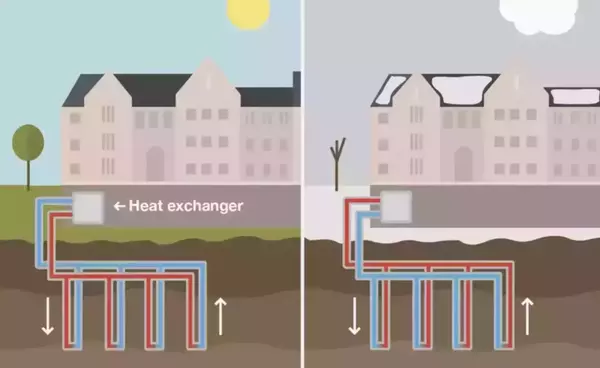
Geothermal exchange, commonly referred to on campus as geothermal, is a technology that harnesses the relatively constant temperature of the earth underground to make heating and cooling buildings more efficient. Notre Dame’s geothermal systems use a network of closed-loop pipes bored approximately 300 feet below ground, where temperatures remain around 50°F year-round. Water circulates through these underground pipes to exchange heat with the earth. This heat exchanger is then used in concert with heat pumps and heat-recovery chillers to produce hot water or chilled water, which is then distributed to campus buildings to support our HVAC systems. Put simply, it takes far less energy to heat a building to 70°F when starting from 50°F underground than from 20°F on a cold winter day!
Notre Dame’s Geothermal Construction
Notre Dame began using geothermal in 2016, when the first geothermal wells were installed as part of a pilot effort to support new campus construction. Since then, the University has installed nearly 2,400 geothermal wells, becoming a core component of Notre Dame’s long-term decarbonization strategy. Well fields on campus include:
-
East Campus Well Field, the University’s first geothermal installation, located near McCourtney Hall.
-
South Campus Well Field, installed beneath the Notre Dame Stadium Parking Lot.
-
Ricci Athletics Well Field, installed beneath the Ricci Athletic Fields to serve athletic facilities.
-
Southeast Campus Well Field, installed beneath parking lots near the Joyce Center and Compton Family Ice Arena.
-
Southeast Campus Geothermal Plant: Construction of a new geothermal plant on the north side of the Joyce Center started in winter 2024. Interior work continues in early 2026 and commission the geothermal equipment and technology.
These projects are being linked into an increasingly centralized geothermal network, with the long-term goal of operating an integrated geothermal heating and cooling system that can serve the campus.
Ready to test your knowledge? Take the quiz for Week 3 here.
Week 2: How Have Notre Dame’s Renewable Energy Projects Advanced Over the Past 10 Years?
Because no single technology can meet all of a campus’s energy needs, Notre Dame has invested in a diverse portfolio of low-carbon and renewable energy projects. Highlights from the last decade include:
-
Geothermal: Notre Dame has installed nearly 2,400 geothermal wells across campus to support heating and cooling, with major installations now completed on East Campus, South Campus, Ricci Athletics, and Southeast Campus. These wells connect to central geothermal plants around campus for distribution. Current projects are focused on interconnecting the plants and expanding the reach of the distribution system, with the plan to eventually create a centralized system to serve campus. Stay tuned to learn more about geothermal next week!
-
Hydroelectric power: ND Hydro is a 2.5-megawatt hydroelectric facility located beneath Seitz Park on the St. Joseph River that began generating power in 2022. By using the natural flow of the river, ND Hydro has the capacity to supply up to 7% of campus electricity demand and prevent approximately 9,700 tons of CO₂ emissions each year, equivalent to avoiding emissions from burning one million gallons of gasoline annually!
-
Solar power: Notre Dame has steadily expanded its solar investments through a combination of off-campus and on-campus projects. In 2021, the University was a founding partner in the St. Joseph Solar Farm, a facility in northern Indiana with a total capacity of approximately 20 megawatts operated by Indiana Michigan Power. In 2023, Notre Dame added the West Campus Solar Array near Dorr Road, which avoids approximately 600-700 metric tons of CO₂ emissions each year, equivalent to taking roughly 130–150 cars off the road annually. Other smaller solar installations exist atop Fitzpatrick Hall and Stinson-Remick Hall.
Ready to test your knowledge? Take the quiz for Week 2 here.
Week 1: How much progress has Notre Dame made on emissions over the last decade?
While there is still work to be done, through collaboration across campus and with community partners, we have achieved a 25% decrease in emissions, despite a 22% increase in gross square footage. Overall, this represents a nearly 40% reduction in emissions per square foot in the last ten years! If you read the Sustainability Strategy, you may have noticed that carbon neutrality by 2050 wasn’t explicitly called out. Thanks to the dedication and progress of team members in Facilities Design & Operations, Notre Dame established a trajectory that enabled us to confidently set 2050 as our neutrality goal.
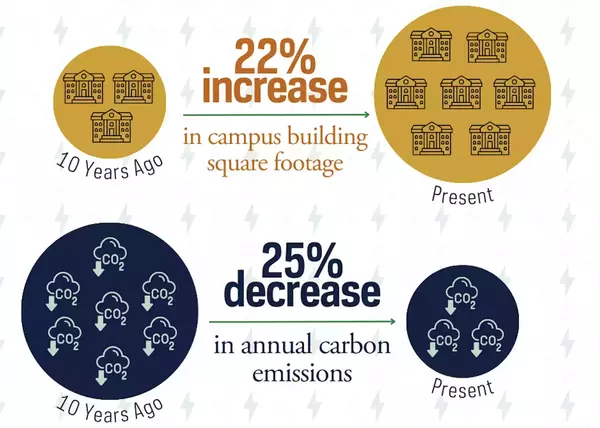
Several efforts throughout the years have contributed to our progress, including:
-
Multiple renewable energy projects, including the construction of geothermal on East Campus, South Campus, Ricci Athletics, and Southeast Campus; ND Hydro, the hydroelectric facility on the St. Joseph River; and solar arrays, such as the West Campus Solar Project. Stay tuned to learn more about these projects!
-
Building efficiency and design improvements, including dozens of building retrocommissioning projects, expanded use of sustainability standards in new construction and major renovations, and more than 206,000 square feet of green roofs across campus.
Ready to test your knowledge? Take the quiz for Week 1 here.
Eager to learn more? View our decarbonization timeline here.