Greenhouse Gas Emissions
This page includes information to enhance literacy about greenhouse gas emissions, demonstrate what Notre Dame is doing to mitigate its emissions, and how to take action as an individual.
Carbon is an integral element of life on Earth. It is found within every living organism, stored in rocks, and resides in our atmosphere as the greenhouse gas, carbon dioxide (CO2). Greenhouse gases (GHGs) are released in various ways, from respiration to burning fossil fuels. While a balanced level of GHGs in the atmosphere is imperative to support life on our planet, anthropogenic GHG emissions are at the center of climate change. Excessive levels of these gases are rapidly increasing global temperatures and disrupting Earth's natural carbon balance. From rising sea levels to elevated utility demands, a hotter climate threatens human well-being, biodiversity, and agriculture, and disrupts the global economy.1

Source: Climate change, causes, economic impact and mitigation.7
What Are Greenhouse Gas Emissions?
Greenhouse gases (GHGs) are gases released in the atmosphere that trap heat. Common GHGs include carbon dioxide (CO2), methane (CH4), and nitrous oxide (N2O). These gases are essential for keeping the planet at a suitable temperature for life to prosper. However, as GHGs become more prevalent in our atmosphere, too much heat remains, causing a disruptive increase in global temperatures.
In order for organizations to address their respective emissions, they must first understand the ways in which their respective emissions are generated. To analyze causes and address impact, GHGs are broken down into three scopes:
-
Scope 1: Direct emissions from sources owned or controlled by an organization. Examples at Notre Dame include the Power Plant and university vehicle fuel consumption.
-
Scope 2: Indirect emissions from sources owned or controlled by an organization. An example at Notre Dame includes the electricity purchased from utility companies.
-
Scope 3: Emissions from sources not owned or controlled by an organization, but are related to their operations and activities. Examples at Notre Dame include students' and employees' commuting to campus, procurement purchases, and emissions related to waste disposal.
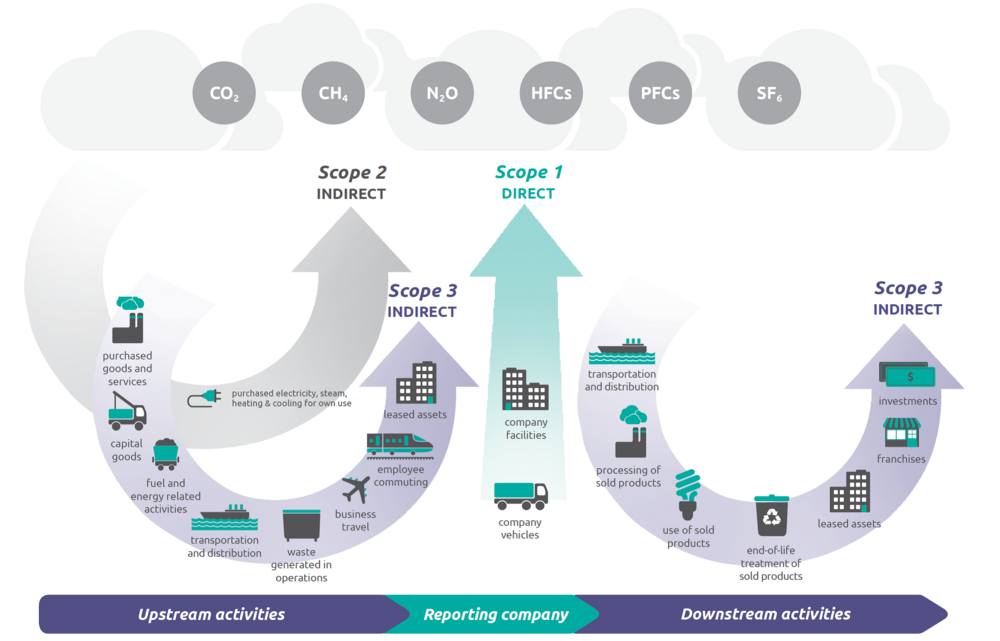
Source: WRI/WBCSD Corporate Value Chain (Scope 3) Accounting and Reporting Standard (PDF).8
How Notre Dame is Working to Reduce Greenhouse Gas Emissions
Notre Dame is dedicated to pursuing holistic and diversified solutions to reduce its GHG emissions as a part of caring for our common home. The University has an aspirational goal of becoming carbon neutral by 2050. As of fall 2024, Notre Dame has achieved a 48 percent reduction compared to 2005, and the University is on target to achieve its goal of a 65 percent reduction by 2030.
Decarbonization is at the forefront of our work. The centerpiece of this transformation is the addition of 2,400 geothermal wells throughout campus and the construction of a new geothermal plant north of the Joyce Center. While we still have much progress to make, a summary of Notre Dame's progress and completed projects can be seen on our carbon neutrality timeline. A sampling of GHG reduction initiatives is listed below.
Continuous Data Analysis
The University has invested in the Sustainability team's capacity to more comprehensively measure Notre Dame's GHG emissions. This work includes expanding the analysis of our scope of emissions and measuring the diverse gases beyond carbon. Continued monitoring and measuring help to inform future work to achieve the University's carbon neutrality goal.
Reducing Fossil Fuel-Driven Utility Demands
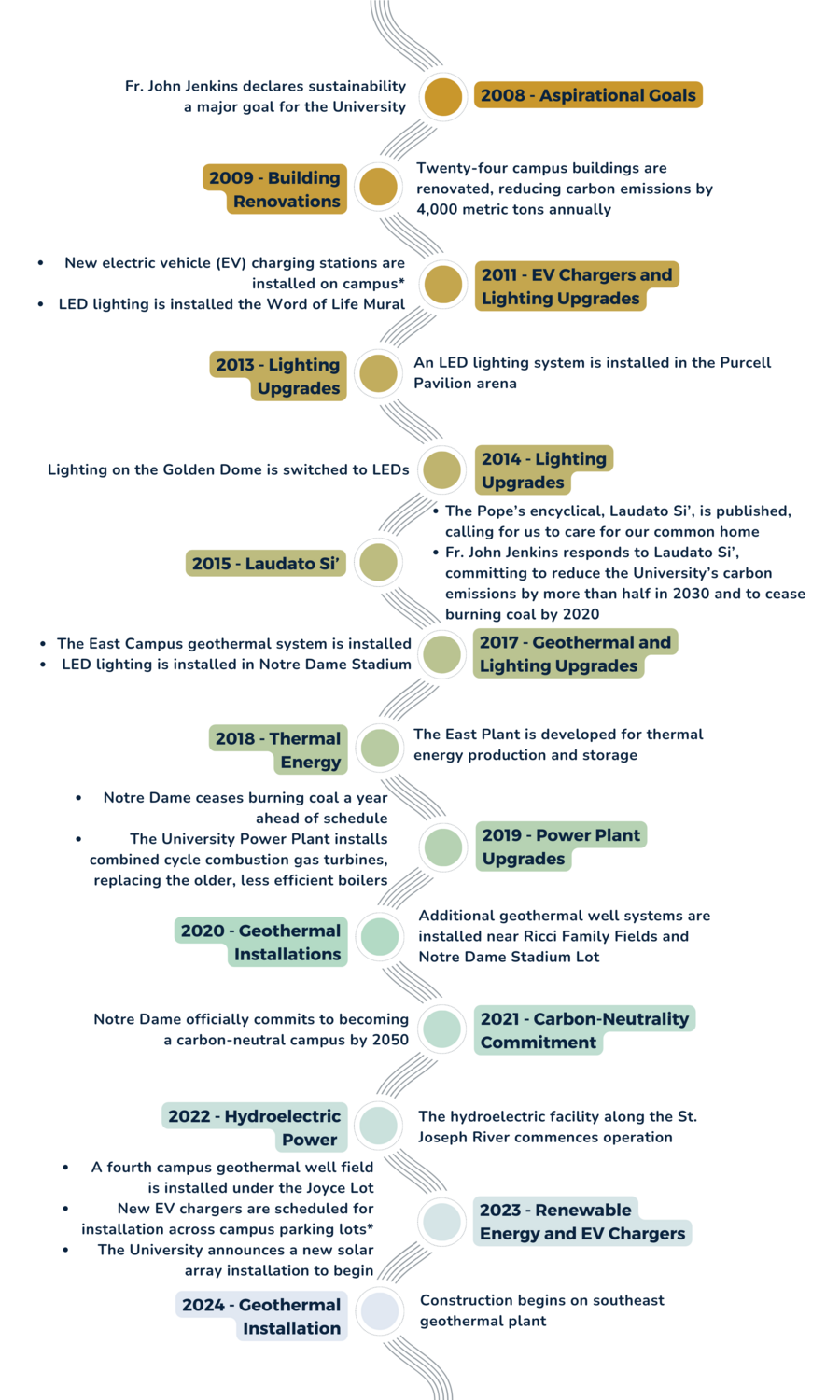
While the campus has grown nearly 40% since 2008, Notre Dame has been able to stave off significant GHG emissions because of the collective work that has been accomplished by the Facilities, Design, and Operations team, primarily to address scope 1 emissions through the power plant and retro-commissioning updates. Such work includes:
Ending Coal Consumption
In 2019, the University ceased utilizing coal and further removed the equipment needed to burn coal at the power plant, to ensure it could not be consumed in the future.
Investing in Renewable Energy
In line with Notre Dame's commitment to achieving carbon neutrality, the University has invested time, money, and energy into securing diverse renewable energy sources. Projects include geothermal, hydroelectricity, and solar arrays. Read more about renewable energy projects on campus.
Retro-Commissioning & Building Updates
Outdated and inefficient fixtures of buildings have been and continue to be updated with efficiency in mind. Specifically, Notre Dame has updated HVAC systems (when possible), automatic light sensors, and converted energy-intensive incandescent light fixtures to LED systems. Notable projects of LED conversion include the Purcell Pavillion, Golden Dome, and campus lamp posts.
Thermostat Set-Point Policy
For buildings that have digitally controlled heating and cooling, sensors maintain each room's temperature between 70°F and 75°F during the time of occupancy but allow it to fluctuate within that range. Allowing the temperature to fluctuate rather than trying to maintain an exact temperature reduces energy use by minimizing the use of mechanical systems. When such spaces are not occupied, the temperatures are allowed to drift further for additional energy savings, with the range expanding from 67°F to 78°F, depending on the season.
Faculty, staff, and students who are not in digitally controlled buildings are asked to adhere to the thermostat set-point policy to keep residential, office, and classroom temperatures below 75° during the heating season and within the 70° to 75° range during the cooling season.
If your thermostat does not respond or cannot maintain the desired temperature, please call the Work Control Center at 631-8888 and request a visit from campus maintenance.
New Building Construction Standards
The University of Notre Dame designs its buildings with long-lasting energy and resource needs in mind. Before starting any new construction project, efficient space utilization is considered. Incorporation of sustainability into our permanent design standards has allowed us to meet the U.S. Green Building Council's LEED certification standards on every new construction project since 2008. Our Green Tour map includes supplementary information.
Fleet Electrification
The University owns numerous vehicles to carry out daily operations. To further reduce its dependence on oil and gas, Notre Dame is actively implementing an electrification plan for its operational fleet. This initiative is being led by Transportation Services, and has resulted in electric vehicle adoption for the motor pool and Parking Services.
Food Initiatives
Food is a complex topic in the realm of sustainability and is related to numerous climate consequences. See our food page to learn about the work Notre Dame is doing to reduce its food-related climate impacts.
How You Can Make an Impact to Reduce Greenhouse Gases
Although managing GHGs can feel out of reach at the individual level, everyone can make contributions that greatly affect the collective action of reducing emissions. Below are just a few tangible options to consider how you can make an impact.
Change Your Relationship with Food
According to Drawdown Solutions, reducing food waste is a top-ranked action you can take to reduce GHG emissions. Changing small habits like taking only what is needed, freezing food, recreating leftovers, and composting are just a few ways to prevent food-caused emissions. See our food page for more details.
Plant-forward diets, such as a flexitarian diet, have the potential to significantly reduce greenhouse gas emissions. Plant-based diets tend to have a lower carbon footprint and show evidence of health benefits.4
Carpool or Public Transit
Gas-powered cars produce CO2 as you drive and burn fuel. Transportation is the largest source of CO2 emissions by Economic Sector in the United States, making up 28% of total GHG emissions. By opting to carpool, you are helping to reduce the amount of GHGs that enter the atmosphere.5
Consider an EV
Whether you're buying a new car or renting one for a trip, consider an EV. The infrastructure for EV charging is rapidly expanding, making it an excellent option for city driving. Notre Dame's motor pool has EV options for rentals to carry out University business. This gives you an opportunity to try before you buy or rent! Our Transportation Services team has a wealth of EV knowledge and will provide you with the information needed to feel confident driving an EV.
Walk and Bike Short Commutes
Walking a mile takes an average of 20 minutes. If your destination is within a couple of miles, consider walking or hopping on a bike to get to your destination. You will reduce your carbon emissions while also improving your health with low-impact exercise.
Turn Off Lights and Electronics When Not in Use
Although the University is diversifying its energy portfolio to become renewable, we still utilize some electricity sourced from natural gas. Turning off lights and electronics when not being used is an easy way to reduce the amount of GHGs entering the atmosphere. After all, 31% of total US CO2 emissions come from the combustion of fossil fuels for electricity; this is 24% of total US GHGs.2
Support Sustainably-Minded Businesses
Manufacturing constitutes 15% of total US CO2 emissions and 12% of total GHG emissions. By choosing to buy from companies that are carbon neutral (any CO2 released into the atmosphere from a company's activities is balanced by an equivalent amount being removed) or even carbon positive (meaning they create an environment for GHGs to be removed from the atmosphere), you can help support the reduction of global GHG emissions.2,6
Adjusting Laundry Habits
Considerable energy is used to heat water for washing clothes and bed linens. When possible, wash your laundry on the cold water cycle to reduce energy consumption. If it's a nice day, consider line-drying your linens outside. You will save energy by skipping the dryer, and your laundry will experience less fiber damage, giving it a longer lifespan.
Purchase Energy Efficient Appliances
When old equipment reaches the end of its lifecycle and you need to purchase new appliances, seek out labels like EnergyStar when considering your options. This label can be found on hundreds of products, from laundry machines to coffee pots. By choosing energy-efficient products, you reduce your energy consumption and utility bills.
Learn more about reduction solutions by visiting Project Drawdown.
Sustainability & Greenhouse Gas Emissions Work Across the University
- From prison to employment: Solar partnership advances Notre Dame's mission, values
- Notre Dame to develop next-generation refrigerant technology as part of a new National Science Foundation Engineering Research Center
- Smarter tools for policymakers: Notre Dame researchers target urban carbon emissions, building by building
- New geothermal plant construction underway
- Third geothermal drilling project installed below the Joyce Lot
- East Plant developed to support geothermal systems
- Solar array atop Fitzpatrick Hall of Engineering
- Kenmore solar array
- Notre Dame Begins Electric Vehicle Transition
- Electric vehicles take charge in campus motor pool
- Notre Dame Charging Forward on Campus’ EV Infrastructure and Programming
- Notre Dame receives the MACOG Clean Air Award
- How the University’s heating and cooling systems work to save energy
- Research points the way to lower energy. costs, better living conditions for low-income households
- World’s biggest polluters are least affected by environmental damage and conflict, new research warns
Sources:
1. National Oceanic and Atmospheric Administration, What is the Carbon Cycle?, n.d.
2. Environmental Protection Agency, Overview of Greenhouse Gases, 2023.
3. UNECE, Sustainable Development Goals, n.d.
5. Environmental Protection Agency, Sources of Greenhouse Gas Emissions, 2023.
7. Climate change, causes, economic impact and mitigation, 2024.
8. WRI/WBCSD Corporate Value Chain (Scope 3) Accounting and Reporting Standard (PDF), 2011.