FAQ Trivia: Spring 2025
The contest below is from a promotion in spring 2025, and the contest is complete. However, the content below is still valuable to learn about some of Notre Dame's sustainability work.
Back by popular demand, Notre Dame Sustainability’s trivia is back for the spring '25 semester! Each week, we will focus on an aspect of campus sustainability and answer some frequently asked questions related to food & dining, energy, building & construction, and more. After each FAQ, we’ll link a Google Form with some trivia questions.
How to play ND Sustainability Trivia:
-
Read each week’s sustainability FAQ.
-
Answer the trivia question by completing the Google Form. Hint: the answer will be hidden in the FAQ.
-
For each week you submit the correct answer, your name will be added to a raffle drawn at the end of the series (end of the spring 2025 semester). The more questions you get right over the course of the series, the better odds you have of your name being selected. The winner of the raffle gets a secret prize.
Ready to become a Sustainability Trivia Champion? Start playing today!
Prize Updates
Thank you to everyone who participated in the spring semester FAQ series. We hope you learned more about the campus recycling program and came away feeling more confident in the process! Congratulations to our winners, senior student Eric Kearns (left) and Assistant Director of the Genomics & Bioinformatics Core Facility Melissa Stephens (right).


Week 11: What is the temperature set-point program?
Small, simple changes in temperature settings can make a big impact on energy use and sustainability. To that end, Notre Dame has implemented the Temperature Set-Point Program.
What is the Temperature Set-Point Program?
The program manages heating and cooling in digitally controlled buildings on campus to optimize energy use. Sensors keep room temperatures between 70°F and 75°F when spaces are occupied.
When rooms are unoccupied, the temperature range is expanded to 67°F to 78°F, for even greater energy efficiency.
Why does allowing temperature fluctuations save energy?
Maintaining an exact temperature requires constant adjustments by heating and cooling systems, which use more energy. Allowing the temperature to naturally drift within a range reduces the workload on mechanical systems.
What if I’m not in a digitally controlled building?
For buildings without digital controls, faculty, staff, and students are asked to:
-
Keep residential, office, and classroom temperatures below 75°F during the heating season.
-
Maintain temperatures within the 70°F to 75°F range during the cooling season.
What should I do if the thermostat doesn’t work?
If your thermostat isn’t responding or can’t maintain the desired temperature:
-
Call the Work Control Center at 631-8888.
-
Request a visit from campus maintenance to address the issue.
Ready to test your knowledge? Take the quiz for Week 11 here.
Week 10: What is ND Hydro, and what makes it unique?
Hydroelectric power isn’t new—people have been harnessing the energy of flowing water for over a century. But Notre Dame’s hydro facility, nestled beneath Seitz Park on the St. Joseph River, takes a modern approach to this age-old energy source.
What is ND Hydro, and how does it work?
ND Hydro is a 2.5-megawatt hydroelectric facility that was officially dedicated in September 2022 and began generating power in May 2022. It has the capacity to provide up to 7% of Notre Dame’s electricity needs.
Here’s how it works:
-
The St. Joseph River has a modest impoundment created by the existing dam between Seitz and Island Parks, creating the necessary headwater to drive the system.
-
By a Federal Energy Regulatory Commission Permit, the University is allowed to utilize any flow greater than the amounts set aside for various features at the site (the Cascade, West Race, East Race, and Fish Ladder).
-
This excess flow can power up to 10 modular turbines depending on water flow. The turbines convert the potential energy created by the head as they spin from the flowing water into electricity.
-
The electricity is sent to campus via an underground transmission line, ensuring a seamless power supply.
What makes ND Hydro unique?
-
ND Hydro is the first facility in North America to use this new modular turbine technology from Voith.
-
The facility has the potential to offset 9,700 tons of CO₂ emissions annually—equivalent to the sequestration of 11,235 acres of US forest in one year— supporting Notre Dame’s goal of carbon neutrality by 2050. Notre Dame worked closely with the city of South Bend, leasing the underground portion of Seitz Park and contributing $1 million to park renovations, which are contributing to South Bend’s riverfront revitalization.
-
Working with the Indiana Department of Natural Resources, significant focus was placed on addressing fish passage around the hydro project, seeking to protect fish and other wildlife from swimming into the turbines.
How has the community benefited from this project?
In addition to powering campus, ND Hydro has supported improvements to Seitz Park, including:
-
A river overlook, offering views of the dam and river.
-
A new performance area for public events.
-
Updated recreational facilities for activities like the East Race Waterway.
Did you know?
The facility’s construction required 1.1 million pounds of steel and 6,700 cubic yards of concrete.
Learn more about ND Hydro and Notre Dame’s sustainability efforts in this article.
Ready to test your knowledge? Take the quiz for Week 10 here.
Week 9: What’s beneath my feet as I walk across Notre Dame?
Geothermal well fields use a series of wells that go 300 feet deep below ground to take advantage of the Earth’s steady 50°F temperature. The wells are connected by pipes with water flowing through them. As the water moves through this closed-loop system, it absorbs heat from the underground surroundings in the winter or releases heat in the summer. In this way, we use the natural temperature of the earth to change the temperature of the water. When the water returns to the building, less energy is needed to either heat or cool the space, increasing our efficiency!
How Does Notre Dame Use Geothermal Wellfields?
Currently, there are nearly 2,400 geothermal wells across various wellfields. These wells connect to various plants that seasonally produce heating hot water and chilled water. As the system grows, the plants will supply more and more campus buildings.
Where Are Notre Dame’s Geothermal Wells Located?
Notre Dame’s geothermal network comprises several locations:
-
East Campus Well Field (2016): The first geothermal well field, which was installed under East Quad to support heating and cooling needs, Ricci Band Building, and Pasquerilla Center is now being connected to the new Southeast Geothermal Plant and was recently expanded as part of the McCourtney 2 project. This wellfield has the ability to be expanded to the east as the campus expands.
-
South Campus Well Field (2017): Approximately 500 wells were installed under the parking lot just south of the Stadium and work in concert with a geothermal plant located in the basement of the Walsh School of Architecture.
-
Ricci Athletics Well Field (2019): Approximately 650 wells were installed under the athletic fields and work in concert with the geothermal plant located in the East Plant..
-
Southeast Well Field (2023): This latest installation consists of 1,008 wells that are located under the parking lots between the Joyce Athletic Center and Compton Family Ice Arena, and are connected to the Southeast Geothermal Plant located on the north side of the Joyce.
Construction of the new Southeast Geothermal Plant on the north side of the Joyce Center is currently underway. When completed, the plant will distribute heating hot water and chilled water to buildings. As part of this project, the East Plant and Southeast Geothermal Plant heating hot water systems will be interconnected to create a central campus heating hot water distribution system. Thus providing greater capacity for this system.

What Are the Benefits of Geothermal Energy?
-
Higher Coefficient of Performance operation by Heat Recovery Chillers that utilize well fields as source and sink of energy have higher efficiencies reducing cost and carbon emissions.
-
As an all-electric energy source system, geothermal can be coupled with renewable energy sources to create a carbon-free heating and cooling system.
-
Their installation reduces strain on local water resources since they are closed-loop systems and do not consume water.
Learn more about geothermal well fields at Notre Dame here.
Ready to test your knowledge? Take the quiz for Week 9 here.
Week 8: What is the white plume from the ND power plant? Is it smoke?
It’s easy to mistake the white plume we see coming from the ND power plant for smoke , but it’s not!
The white plumes rising from the Notre Dame power plant are often mistaken for smoke, but it is actually steam, which is a byproduct of the power plant’s Combined Heat and Power (CHP) system. CHP, also known as cogeneration, is an energy-efficient process that simultaneously generates electricity and heat from a single fuel source. Unlike traditional power plants, which generate only electricity and release excess heat as waste, CHP captures and repurposes that heat.
Here’s how Notre Dame’s CHP system works:
- The power plant burns natural gas in either a gas turbine or boiler. In a gas turbine case, the exhaust gases from what is essentially a jet engine spin a turbine to make electricity and the waste heat enters a form of a boiler to also create steam.
- In the case of a boiler, the fuel combusted heats water to make steam.
- In both cases, the resulting steam is used to drive a steam turbine which produces electricity.
- The steam leaving the steam turbine (at a lower pressure) is then used in campus buildings for heating or other uses such as heating domestic hot water.
Thanks to the use of the combined cycle operation of the gas turbines and cogeneration cycle using the steam turbines, Notre Dame’s power plant operates at up to 70% efficiency, nearly double that of traditional electricity-producing-only power plants.
* It’s important to note, however, that at Notre Dame, cogeneration is just one part of our broader strategy to meet campus energy needs—about half of the electricity used on campus is generated on-site through CHP, while the other half is purchased from external sources.
Ready to test your knowledge? Take the quiz for Week 8 here.
Week 7: Green Roofs at Notre Dame
The following are questions we often receive about green roofs during our campus Green Tours.
What is a green roof, and what benefits do they provide?
A green roof, or living roof, is a rooftop covered with vegetation planted over a waterproof membrane. Green roofs provide several immediate and long-term benefits, including:
-
Insulating buildings to keep interiors cooler in the summer and warmer in the winter.
-
Shielding roof membranes from UV radiation and extending their lifespan.
-
Preventing "thermal shock," which can be caused by a hot roof that is rapidly cooled by a rainstorm. Such events can damage the roof membrane over time.
-
Capturing and conserving rainwater, reducing stormwater runoff.
-
Supporting biodiversity by providing food sources for beneficial pollinators, like birds and bees.
-
Reducing the heat island effect and lowering ambient temperatures.
What green roofs exist at Notre Dame?
At the time of writing, Notre Dame has eight green roofs, totaling nearly 155,000 square feet.
-
Joyce Center: The largest green roof in Indiana, spanning almost 68,900 square feet
-
O'Neill Hall of Music (20,500 SF)
-
Corbett Family Hall (10,300 SF)
-
Morris Inn (8,300 SF)
-
Duncan Student Center 22,100 SF
-
Alumni Hall 1,300 SF
-
Eck Hall of Law 2,130 SF
-
Rockne Memorial 21,380 SF
For the most up-to-date list of green roofs and other sustainability initiatives, check out our Sustainability Map.
What do Notre Dame’s green roofs look like?
Notre Dame’s green roofs feature vibrant plant layouts designed for aesthetics and sustainability. The Joyce Center green roof, pictured below, includes 25 plant species, primarily sedums, arranged in interlocking trays to create a lush, patterned surface.

Are all buildings suitable for green roofs?
Green roofs are significantly heavier than traditional roofs due to the weight of soil, plants, and irrigation systems, making them unsuitable for all buildings. At Notre Dame, engineers account for this by assessing each building’s structural capacity during construction or retrofit planning to ensure that only buildings capable of safely supporting the additional load are considered for green roofs.
For more pictures and information on the expansion of green roofs across campus, consult this story.
Ready to test your knowledge? Take the quiz for Week 7 here.
Week 6: What’s Happening with Electric Vehicles at Notre Dame?
Notre Dame is building the foundation for a more sustainable future with its growing network of electric vehicles (EV) and charging stations. Here’s what you need to know about the expanding EV infrastructure on campus.
Is Notre Dame Electrifying Its Fleet?
Yes, Notre Dame has begun transitioning some of its operational vehicle fleet to electric as part of its decarbonization strategy. As the world of electric vehicles evolves, the University will be closely monitoring the EV market to ensure it is as up-to-date as possible on new technologies and innovations for lower-emission vehicles.
What’s Already Happening?
Over the past year and a half, Sustainability and Transportation Services have worked together to introduce EVs into the University’s fleet. Here’s what you’ll see around campus:
-
Parking Services Department Ford F-150 Lightning (all-electric pickup truck).
-
Utilities Department Hyundai Kona (all-electric SUV).
-
Four all-electric EVs and several additional plug-in hybrid vehicles are available for University-related business travel.
-
Electric golf carts for inter-campus commutes.
What About Charging?
As of writing, Notre Dame has 10 EV charging stations. You can find the locations of those on the Parking Services EV page. Notre Dame is working with its operational partners and collecting data to thoughtfully plan for future charging stations to meet the needs of campus.
Charging is limited to 4 hours per 24-hour period and is available to Notre Dame students, faculty, and staff with valid parking permits. Visitors are encouraged to use nearby off-campus charging facilities like those at University Park Mall.
What's Next?
Complete fleet electrification will take time, as vehicles are replaced when they reach the end of their lifecycle. In the meantime, Notre Dame will continue identifying opportunities to choose EVs.
Ready to test your knowledge? Take the quiz for Week 6 here.
Week 5: Recycling Changes All the Time. How Can I Keep Up With Guidelines and Best Practices?
Recycling guidelines can feel like a moving target. Here’s some information on how you can keep up with Notre Dame’s recycling program and make sure you’re recycling correctly.
Why do recycling guidelines change?
Recycling guidelines evolve due to changes in local recycling infrastructure, global market demand for materials, and updates from our service provider, Recycling Works.
Where can I find the most up-to-date recycling information?
Notre Dame’s A-to-Z Recycling Directory is your go-to resource for recycling guidance. It’s regularly updated to reflect any changes to what can and cannot be recycled. Our Where and How to Recycle page lists answers to frequently asked questions. Please also feel free to email green@nd.edu if you have other inquiries.
What materials can I recycle on campus?
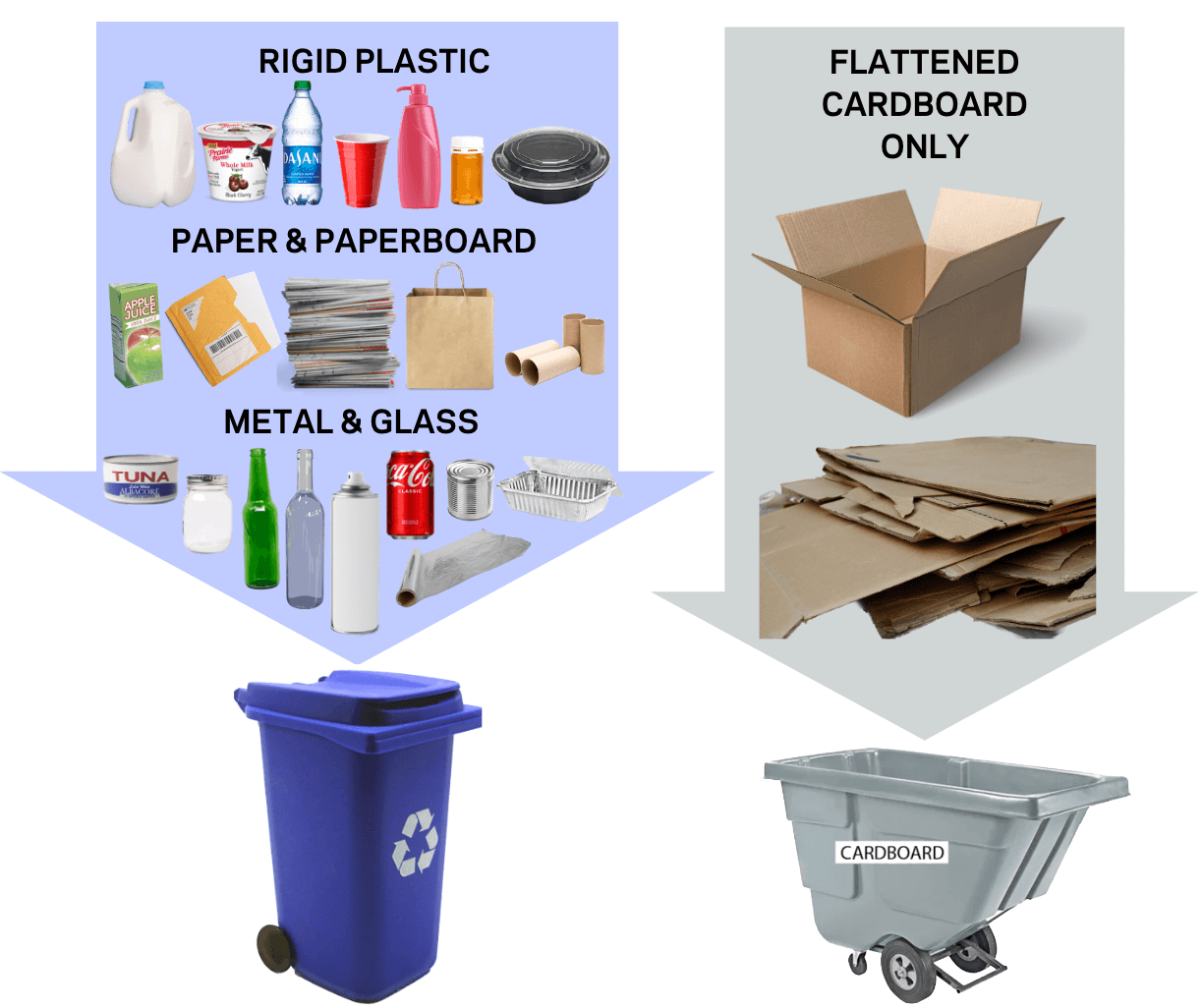
Notre Dame’s single-stream recycling program accepts items like aluminum cans, glass
bottles, rigid plastics, and paper all in one container. To ensure proper recycling, please:
-
Empty all liquids and food before placing items in recycling toters.
-
Check the A-to-Z Directory for detailed information.
Some items like plastic bags and batteries require separate handling.
-
Cardboard takes up considerable space in the single-stream toters—it should be flattened and placed in the designated gray cardboard carts.
-
Plastic bags are considered contaminants and cannot go in single-stream bins. Student Government has launched a student-led plastic film collection program pilot in select residence halls. If you’re a student interested in this program, check with your hall’s Sustainability Commissioner.
-
Batteries
-
Lithium-ion, button-cell, and rechargeable types can be recycled by submitting a work order request.
-
Alkaline batteries should be disposed of in the landfill.
For details on other items that require special handling, like electronic waste, refrigerators, and furniture, please visit our specialty recycling page, which explains how to properly recycle items that cannot go into single-stream recycling bins.
How clean do materials need to be?
Recyclables should be relatively clean, dry, and empty to prevent contamination. They don’t need to be spotless, but a quick rinse can make a big difference.
How can I get involved?
-
Be a recycling advocate. Educate yourself and others about recycling best practices.
-
Volunteer. Join sustainability events or offer feedback on how to improve recycling in your building. During football season, we also need Recycling Green Team Members, who hand out recycling and landfill bags to incoming tailgaters.
-
Ask questions. Reach out to the Sustainability Office to share ideas or concerns.
Ready to test your knowledge? Take the quiz for Week 5 here.
Week 4: What happens to Notre Dame’s leftover cooking oil?
It’s easy to overlook what happens to cooking oil after it’s used. With RTI Oil Management, Notre Dame ensures that we responsibly manage spent cooking oil.
What is RTI Oil Management, and how does it work?
Restaurant Technologies, Inc. (RTI) Oil Management is a system used by Campus Dining to manage cooking oil in a safer and more effective way. The system supplies fresh, clean oil to kitchens and disposes of used oil with the click of a button. It's a contactless process that eliminates packaging waste and simplifies disposal.
Why is this system important?
RTI Oil Management helps reduce waste and makes oil disposal safer and easier for staff.
Plus, it ensures that used oil is recycled instead of being thrown away. Most of the used oil (90%) is recycled into biodiesel—a cleaner, renewable energy source.
What is biodiesel, and why is it better for the environment?
Biodiesel is a renewable fuel made from organic materials like used cooking oil. It can reduce:
-
Carbon dioxide emissions by up to 74% compared to regular diesel.
-
Carbon monoxide and soot particles, which contribute to air pollution.
Using biodiesel also helps lower greenhouse gas emissions and improves air quality, making it a cleaner alternative to traditional fuels.
What happens to the 10% of oil that can’t be turned into biodiesel?
The remaining oil is transformed into animal feed.
Ready to test your knowledge? Take the quiz for Week 4 here.
Week 3: How does Notre Dame partner with Cultivate Food Rescue?
Have you ever enjoyed a catered meal at a campus event? Many of us have. Event planners work hard to prepare just the right amount of food for each gathering, but sometimes there’s surplus that hasn’t been served. When that happens, Notre Dame’s catering teams ensure it stays at safe temperatures and, whenever possible, donate it so others can enjoy a great meal.
Since 2017, Notre Dame has partnered with Cultivate Food Rescue, a South Bend-based nonprofit committed to reducing food waste and fighting hunger in the Michiana area. Cultivate recovers surplus food and repurposes it into nutritious meals, helping to feed those in need while also minimizing waste.
One of Cultivate’s signature initiatives is the Weekend Backpack Program, which provides meals to K-12 students facing food insecurity.
Here’s how the program works:
-
Notre Dame’s dining halls, athletic events, and other local partners follow strict food safety protocols and ensure donated food remains at safe temperatures until it is handed off to Cultivate.
-
Cultivate collects the unused, high-quality food.
-
The rescued food is portioned into balanced, ready-to-eat meals at Cultivate’s facilities.
-
Meals are distributed to students in our community.
How has Notre Dame contributed to this program?
-
In the 2023-24 academic year, Notre Dame contributed 23.23 tons of food to Cultivate, helping sustain the Weekend Backpack Program and other initiatives.
-
The University continues to donate excess food from Campus Dining, athletic events, and large gatherings.
Learn more about Cultivate Food Rescue at cultivatefoodrescue.com
Ready to test your knowledge? Take the quiz for Week 3 here.
Week 2: What's "pre-consumer waste," and how does Notre Dame tackle it in Campus Dining halls?
Notre Dame’s dining halls serve thousands of meals daily, but not all waste starts on a student’s plate. “Pre-consumer waste” refers to food discarded before it ever reaches the serving line—unavoidable trim waste during preparation, leftovers from over-preparation, spoiled ingredients, or items that didn’t meet quality standards. Tackling this waste is a critical part of Notre Dame’s sustainability strategy. This is where Leanpath comes in.
What is Leanpath?
Leanpath is a food waste prevention software that Notre Dame adopted in 2015 to measure, analyze, and reduce food waste in its dining halls and culinary facilities.
How does Leanpath track pre-consumer waste?
-
When food is discarded, staff weigh it, photograph it, and input the reason for disposal (e.g., overproduction, spoilage).
-
The system links the data to identify patterns, such as specific items that are consistently wasted.
-
Staff make targeted adjustments to reduce waste based on the data.
What does Leanpath reveal about food waste?
Leanpath’s detailed approach helps Campus Dining address issues like:
-
Overproduction: For example, if lasagna trays are repeatedly discarded untouched, it may indicate that fewer portions are needed.
-
Storage Concerns: Spoiled produce in photos may indicate inefficiencies in purchasing or refrigeration.
-
Forecasting Improvements: Data helps staff fine-tune portion sizes and menu offerings to better match demand.
What’s next for food waste reduction at Notre Dame?
Notre Dame is looking to expand Leanpath to complement the existing Grind2Energy program, which already processes waste into nutrient-rich slurry for renewable energy and fertilizers.
Ready to test your knowledge? Take the quiz for Week 2 here.
Eager to learn more now? Find more information about Notre Dame Sustainability here and additional details about the intersection of food and sustainability here.
Week 1: What is the EPA Wasted Food Scale, and how does Notre Dame follow it?
Reducing food waste is one of the most impactful ways to protect the environment, conserve resources, and fight hunger. The EPA Wasted Food Scale outlines the most effective strategies for managing food waste, and Notre Dame adopts practices that align with these strategies to handle food waste sustainably.
What strategies are included in the EPA Wasted Food Scale for managing food waste?
-
Prevent Wasted Food (most effective): Prevent food waste at its origin by purchasing and preparing only what is needed.
-
Donate or Upcycle: Donate surplus food to food banks, shelters, or other organizations.
-
Feed Animals or Leave Unharvested: Use food scraps as animal feed to avoid waste. Farmers may also leave unused crops unharvested to return nutrients back to the land for future growing seasons.
-
Compost or Anaerobic Digestion: Recycle food waste into nutrient-rich compost to enrich soil or use anaerobic digestion with beneficial use of biosolids.
-
Anaerobic Digestion or Apply to the Land: Anaerobic digestion with disposal of biosolids or apply to the land for soil amendment.
-
Landfill/Incineration (avoid whenever possible): The least preferred option, as it contributes to greenhouse gas emissions and resource loss. The EPA estimates that in the U.S. alone, 24% of municipal waste in landfills is food, and is responsible for 58% of landfill methane emissions into the atmosphere.1
How Does Notre Dame Follow the EPA Wasted Food Scale?
-
Prevent Wasted Food (most preferred):
-
In 2015, Notre Dame adopted Leanpath, a food waste prevention tool that helps track and analyze discarded food in the dining halls. Stay tuned to learn more about Leanpath and its impact at a later date in this FAQ series!
-
Donate or Upcycle (most preferred):
-
Notre Dame partners with Cultivate, a local nonprofit that repurposes surplus food from campus dining halls into frozen meals for food-insecure individuals.
-
Feed Animals:
-
All of our vegetable trimmings are donated to a local cattle farmer to help feed their herd.
-
Anaerobic Digestion with Beneficial Use of Biosolids:
-
Food waste that cannot be donated is processed through the Grind2Energy system, which turns it into a liquid slurry.
-
The slurry is delivered to a local farm called Homestead Dairy, where anaerobic digesters convert it into biogas (a renewable energy source that powers farm operations), fertilizer, and animal bedding.
Ready to test your knowledge? Take the quiz for Week 1 here.
Sources: