Game Day Sustainability
The Fighting Irish don’t just wear green, we live it. From our dedicated fans in the stands recycling their bottles and cans, to the operators behind the scenes, sustainability efforts can be seen across campus and athletic spaces. We are working together to care for our common home.
Tailgating Tips Green Infrastructure All Around YouMitigating Food WasteEV Charging
Stadium Recycling
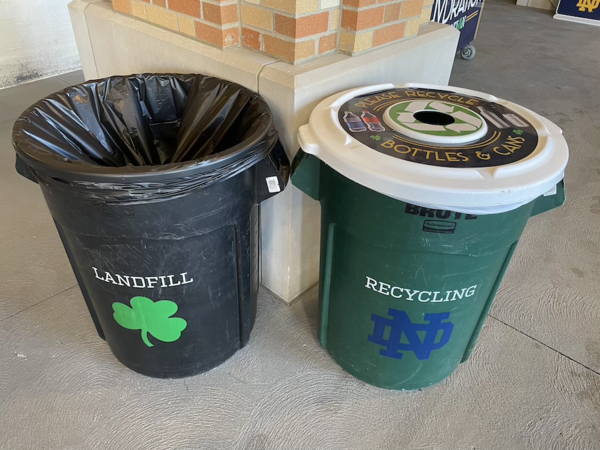
Look for green barrels labeled “Recycling” inside the Stadium to discard your empty bottles, cups, and cans. Everything else goes in the black barrels marked “landfill.”
Tailgate Recycling

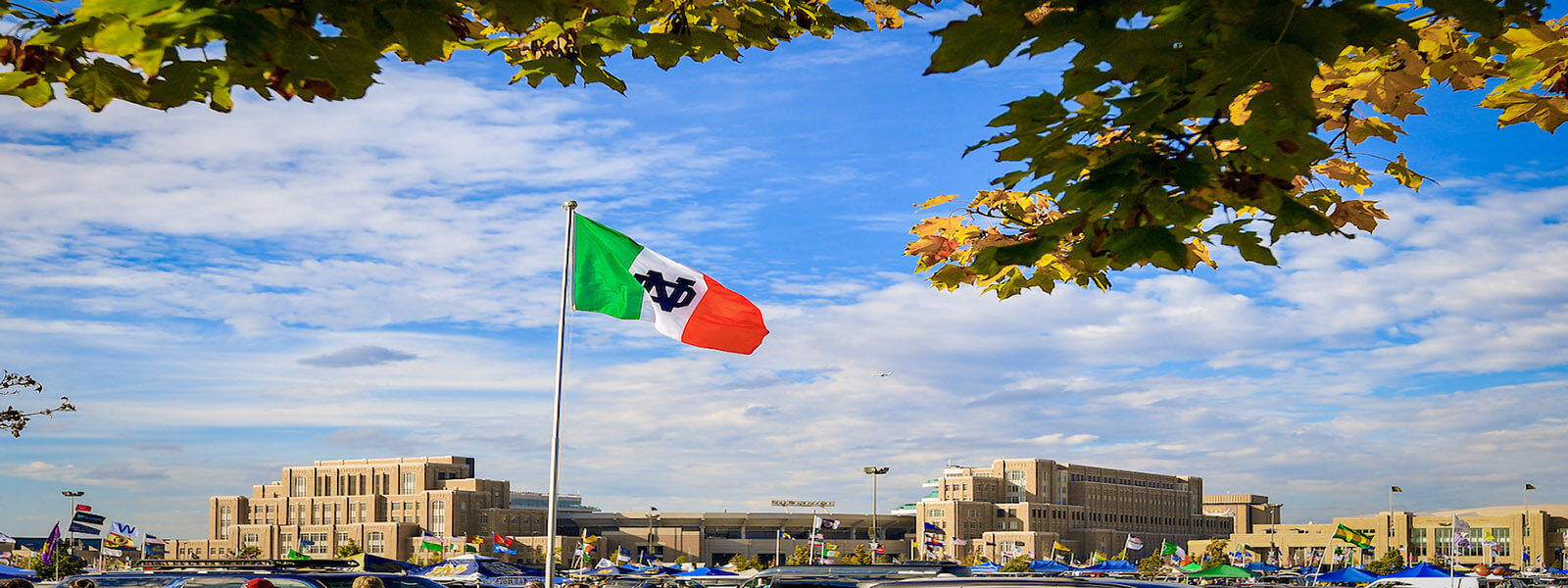
The tradition of tailgating at Notre Dame has become as popular and as important as attending the game itself, with many fans considering tailgating the ultimate game day experience.
If you are tailgating in our parking lots, we offer two ways to support recycling:
Blue Recycling Barrels
Blue recycling barrels are paired alongside landfill barrels all over campus. If you are walking around the lots and other parts of campus, dispose of your recyclables in the blue barrels labeled with a recycling symbol. Everything else should go in the white barrels labeled “landfill.”
Blue Recycling Bags Provided by Student Green Team
Tailgaters arriving early in key tailgating lots are offered blue recycling bags (and black landfill bags) at the entrance to designated lots. If you are at a designated tailgating spot, dispose of your recyclables by placing them in one of the blue bags provided by our Green Team members at the entrance to designated lots.
Anything that can be recycled in our single-stream program can be placed in the blue bags. Everything else is considered trash and should be placed in the black bag provided to you. You may also use your own black bags. Anything not in a blue bag is considered trash.
Prior to kick-off, leave both bags behind your vehicle, and they will be picked up during the game. Leaving the blue bag untied is helpful so staff can easily remove the materials.
Tailgating Waste Reduction Tips
To help you score a winning touchdown with your tailgate, we’ve compiled a list of our top 5 tips to help make your Game Day the greenest it can be.
Tip #1: Reusables, Reusables, Reusables
We can’t talk about sustainable tailgating without the word reusables. Consider your options for reusable tablecloths, beverage containers, and drink dispensers. Single-use plastic cups are common for outdoor events. Instead of the classic red cup, consider purchasing aluminum cups for you and your guests, which are sturdier than plastic solo cups, infinitely recyclable, and can even be washed and reused! Choose reusable serving utensils like plates and silverware. Instead of plastic plates and utensils, reach for items that can be washed and used again. If you choose to go with a disposable option, consider items made with biodegradable materials like sustainably grown bamboo or paperboard.
Tip #2: Have a game plan for your leftovers
Food is a staple for any good tailgate! Often, leftover food remains when the game begins. Think about ways you can minimize food waste by making a game plan for your leftovers. To prevent throwing food away, bring reusable containers and a cooler that can be stowed away in your vehicle while enjoying the game. This will help ensure your leftovers stay fresh and can be consumed after an Irish victory. Wasted food is the single largest category of material placed in landfills. Help the Fighting Irish fight hunger by feeding people instead of landfills.
Tip #3: Purchase only beverages in recyclable containers
We’ve made recycling outside of the stadium convenient and easy for our tailgate fans. We highly encourage you to purchase beverages in containers that can be recycled, like aluminum, glass, or plastics #1-2. Pro tip: prioritize infinitely recyclable materials like aluminum and glass! See our A-Z Recycling Directory for a complete list of recyclable materials.
Tip #4: Have something to collect your soiled, reusable dishware in
Try a pop-up hamper to collect your reusable soiled cups, plates, and serving utensils. Having a designated place where your guests can leave their used cups, plates, and serving utensils helps keep your tailgate area neat and tidy, making for an easy clean-up before heading into the game.
Tip #5: Get creative, enjoy your tailgate, but leave no trace
Challenge yourself to be as green as possible when planning your tailgate - or try one new sustainable action each game. Providing clearly designated trash and recycling receptacles for your guests is a great way to keep your tailgate area neat and tidy for easier clean-up. That way, you can get into the stadium in time for kick-off. Adopt the best practice of pairing your recycling and trash containers side by side to force your guests to make a decision between the two. Spoiler alert: humans will almost always go for the easiest option, so if they are not side by side, your guests may choose to put whatever they have into whatever bin happens to be closest!
Leaving nothing behind, including your tailgate accessories like games, chairs, tables, and banner flags, even if they are broken, is one of the best things you can do to ensure everyone has a great tailgate experience.
Green Infrastructure All Around You
Numerous sustainable infrastructure investments have been made across campus and within the Athletics spaces that often go unseen to campus constituents. Below are some notable highlights of Notre Dame’s commitment to creating a more sustainable future for all of us.
Green Roofs

Along the campus skyline, the University has committed to establishing vegetative “green” roofs where possible. Green roofs can provide several environmental and structural benefits: they enhance building insulation to lower energy demands, reduce the urban heat island effect, provide pollinators with additional food sources, and improve stormwater management by absorbing and filtering rainwater. Additionally, green roofs can extend the lifespan of buildings by shielding roof materials from UV radiation and temperature fluctuations.
One of the most notable campus green roofs sits atop the Joyce Center. This green roof is the largest in Indiana at 68,900 square feet. Spanning nearly two acres, it features over 32,000 trays of plants from 25 different species. Learn more about Notre Dame’s vegetative “green” roofs.
Geothermal Energy

Below the Stadium Lot, Joyce Lot, and numerous other sites across campus, geothermal well systems have been installed to support heating and cooling of our campus buildings. Geothermal systems are a pillar of the University’s long-range plan to reduce its greenhouse gas emissions, nearing ever closer to the goal of becoming carbon neutral by 2050. With over 2,400 wells now working below the surface of campus, the Facilities Design and Operations team is working on the Southeast Campus Geothermal Plant. Once completed, the new geothermal plant will support heating distribution to buildings in the southeast region of campus and cooling throughout all of campus.
Geothermal systems support sustainable energy usage for heating and cooling buildings on campus. By utilizing a network of water-filled pipes buried underground, they take advantage of the year-round 50°F average temperatures below the Earth’s surface, circulating water in a closed-loop piping system to a depth of roughly 300 feet before returning it to the surface and distributing it through an energy center. By starting the heating and cooling process at the 50°F baseline, significantly less energy is used to create comfortable building temperatures. Learn more about Notre Dame’s geothermal progress.
Shade in the Parking Lots Supported by Underground Silva Cells
Below the trees throughout Notre Dame’s parking lots, the University utilized silva cells during lot construction. These cells are grid-like systems that allow tree roots to grow freely underground without disrupting the pavement. Healthy trees among paved areas and walking paths help reduce heat island effects, keep urban temperatures cooler, support biodiversity, and absorb rainwater to reduce the severity of flooding events.

LEED-Certified Buildings
Since 2008, Notre Dame has been committed to constructing and retrofitting campus buildings to meet the Leadership in Energy and Environmental Design (LEED) certification, a globally recognized standard for sustainable architecture awarded by the U.S. Green Building Council. Notable campus builds include:
- Campus Crossroads (Duncan Student Center, Corbett Hall, and O’Neill Hall), LEED-certified Gold
- Compton Ice Arena, LEED-certified Silver
- Irish Athletics Center, LEED-certified Silver
- Purcell Pavilion at the Joyce Center, LEED-certified Gold
Building with LEED certification in mind is critical for stewarding precious resources and protecting human health. Some of the building considerations that factor into a LEED score include categories such as water efficiency, energy efficiency, biodiversity, indoor environment quality, and building materials & resources. Learn more about Notre Dame’s LEED Certified Buildings.
Lighting Projects

Campus has systematically updated its lighting fixtures to save energy, making LEDs the standard. Since its upgrade in 2013, the Purcell Pavilion arena at the Joyce Center has reduced energy consumption by 73% while improving light levels and controllability. In addition to saving approximately 469,000 kilowatt hours annually, equivalent to taking 63 passenger cars off the road, the long life span of LED bulbs virtually eliminates maintenance costs. This crisp, improved lighting also enhances the game experience for players and fans, and campus photographers note that the quality of LED lights enhances their ability to capture moments on the court.
Capturing Food Waste

In the United States, nearly 40% of food is wasted, yet many of our neighbors struggle with food insecurity. After stadium events, edible food is donated to our neighbors in need. The University maintains an ongoing partnership with Cultivate Food Rescue to provide high-quality, well-balanced meals to food-insecure families throughout the Michiana area. Food is rescued from events as well as ongoing campus operations. Cultivate “rescues” and reuses food through multiple programs, including a weekend backpack program to feed K-12 students facing poverty. Learn more about Notre Dame’s food waste efforts by visiting our Food page.
EV Chargers
To the fans arriving on campus via electric vehicle, Notre Dame has charging stations available in the Joyce Visitor Lot and Bookstore Visitor Lot. See NDPD’s Electric Vehicles page to learn more. Note: Access to these chargers is impacted by gameday parking protocol.
Curious to learn more about how Notre Dame is working to care for our common home? Check out our sustainability timeline or download our digital green tour map.