University of Notre Dame Sustainability Strategy
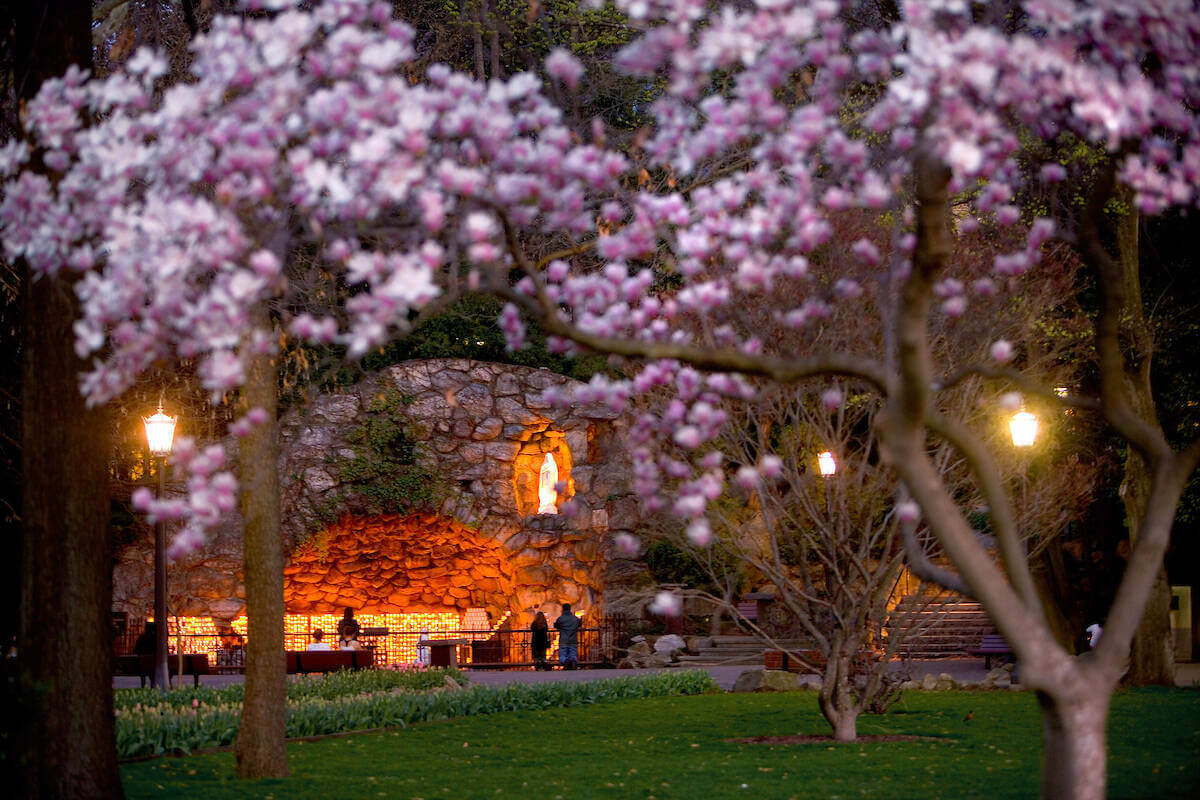
2026 marks a decade since Notre Dame published its original Comprehensive Sustainability Strategy on the heels of Pope Francis’ encyclical, Laudato Si’. While we continue our ongoing work, we are taking this moment to recognize key achievements, many of which occur behind the scenes and are not evident to the everyday Notre Dame community member.
We invite you to review the history of our strategy that has led us to our achievements so far.
Check back with us as we add achievements that elevate the complex, difficult work of campus operators who strive each day to create a campus community that exemplifies Pope Francis' call to Care for Our Common Home. Notable areas of progress include decarbonization, green roofs, food waste diversion, and the built environment.
Decarbonization

Over the last 10 years, despite the campus' physical footprint growing by 22 percent, the University has decreased its annual carbon emissions by 25 percent! This has been achieved through the consistent dedication of team members in Facilities Design & Operations, who have been at the helm of powering Notre Dame while continuing to upgrade and develop our campus.
Learn more:
Highlighting progress: Sustainability data demonstrates a year of achievements
See how Notre Dame is working to decrease greenhouse gas emissions.
LEED Buildings

Since 2008, Notre Dame has been committed to constructing campus buildings to meet the Leadership in Energy and Environmental Design (LEED) certification, the leading globally recognized standard for sustainable architecture awarded by the U.S. Green Building Council. In the last decade, 17 buildings earned LEED Silver or LEED Gold certification, bringing the campus total to 26 LEED-certified buildings! Examples include:
- Morris Inn, LEED certification: Gold
- Duncan Student Center, LEED certification: Gold
-
Compton Family Ice Arena, LEED certification: Silver
Learn more:
See the complete list of LEED-certified buildings on campus
See how Notre Dame is addressing its impact through building & construction efforts

Green Roofs
Green roof infrastructure on campus has greatly expanded in the last decade. Currently, Notre Dame cares for over 212,000 square feet of green roofs across ten campus buildings—an area the size of approximately 3.5 football fields! They host numerous benefits that add longevity to a building’s roof over a traditional membrane roof, including protection from ultraviolet radiation, thermal shock, and standard weathering. The layer of soil and vegetation aids in insulating buildings, which saves money and energy from heating and cooling efforts. Living roofs are also helpful in supporting local pollinator populations and diverting stormwater runoff to help prevent flooding events.
Learn more:
ND Works Podcast: Green roofs at Notre Dame with Tony Polotto
Green roofs continue to grow across campus skyline
See how Notre Dame is Addressing Its Impact Through Building & Construction Efforts
Strategy Overview
Following the teachings of our Catholic tradition and mission, and further inspired by the late Pope Francis, the Executive Vice President’s Comprehensive Sustainability Strategy Committee was convened to assess our current sustainability practices and promote the future protection of God’s creation at Notre Dame.

The following highlights key milestones leading up to and since the Committee was formed:
- 2008 - President Jenkins communicates sustainability as a priority
- 2008 - Notre Dame's initial Office of Sustainability is created
- 2011 - ND begins offering two interdisciplinary sustainability-focused minors
- 2015 - Comprehensive Sustainability Strategy Standing Committee (composed of students, faculty, & staff) initially convened
- 2016 - Comprehensive Sustainability Strategy published
- 2017 - Small Working Groups (composed of students, faculty, & staff) are organized and begin work in seven areas of focus
- 2021 - University commits to becoming a carbon-neutral campus by 2050
- 2022 - Notre Dame receives updated STARS rating
- 2023 - Notre Dame begins planning process for updating the Sustainability Strategy
- 2023 - Climate change and the environment included as a theme in Notre Dame 2033: A Strategic Framework
- 2024 - QS World University Rankings identifies Notre Dame as 226th in the world for sustainability
- 2024 - Sustainability Strategy update continues via Climate Action Planning
A more detailed decarbonization timeline is also available.
Small Working Groups were assembled to support the key focus areas within the Comprehensive Sustainability Strategy. These working group members developed goals and recommendations to enable the University to widen and deepen sustainable practices across all its activities and functions. In addition to the Strategy noted above, some of their work is highlighted via the links below.
- Successes from the 2016 Comprehensive Sustainability Strategy
- Progress Update from the 2016 Comprehensive Sustainability Strategy
With support from the Sustainability Strategy Standing Committee, we paused the regular convening of the Small Working Groups in order to move toward the next phase of an updated Strategy for the University. In order to maintain a connection with our valued Small Working Group membership, the Sustainability Collective was created. This Collective of all working group members together allows us to continue to collaborate while we pilot our strategic sustainability planning process. We honor and appreciate the achievements and vision of the Small Working Groups and their leadership.
We are grateful for the members of the working groups who worked to establish a strong foundation of sustainability at the University.